
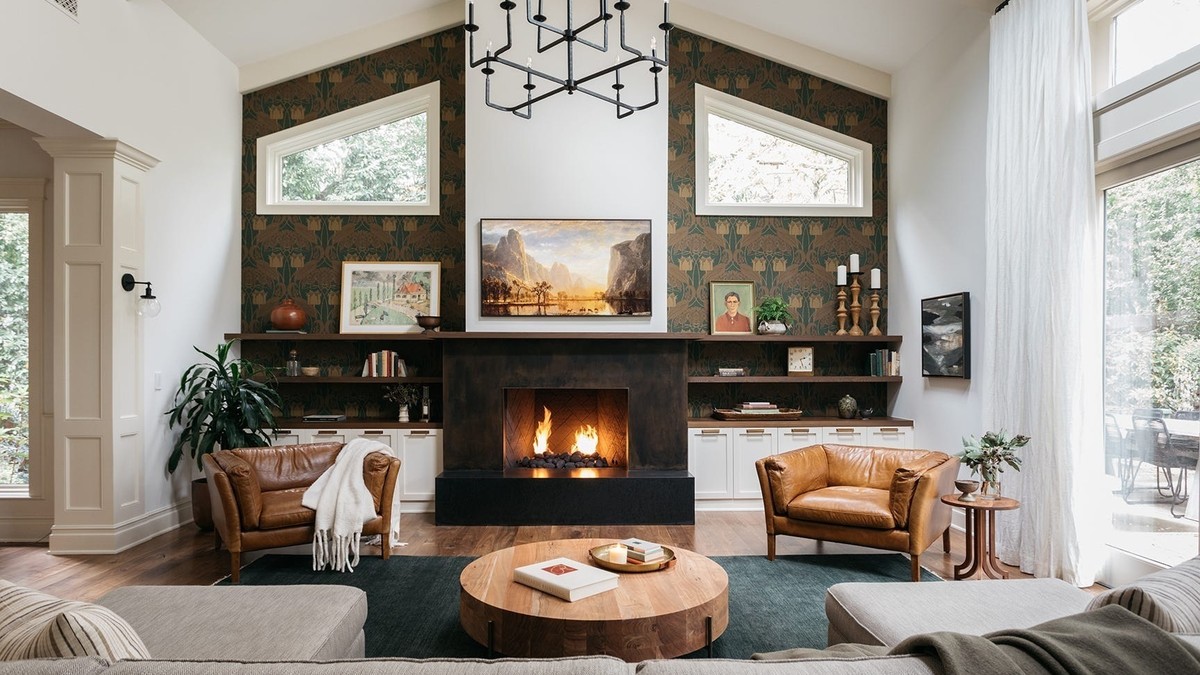
Ever walk into a room and have your gaze naturally attracted to a certain object or place almost immediately? Everything else may seem a blur as your focus on that area. That is the focal point, or the point of emphasis, in interior décor language. Even if the focal point is inconspicuous, your eye will generally move around a room in search of a place to rest its gaze upon.
Take a look at these two images and try figure out the focal points in the décor.
Credit: Mark Lawrence on Flikr
Credit: Houzz.com
For me, the focal points were colorful paintings on the wall. How about you?
What makes a room’s focal point?
In interior design, a focal point is intentionally created, if it doesn’t exist naturally, to provide the necessary emphasis that holds the room together. Examples of focal points that command your attention and dominate the room can be:
- A fireplace,
- A picturesque window with a good view, but the focal point will disappear at night, unless the window itself is decorated.
- Colors too can create a focal point in a room. In a room with a monochromatic color scheme, composed of various shades of blue for instance, a bright painting or any contrasting colors (such as yellow and red) will provide a focal point. This will also add a note of excitement to the room.
- Textures and patterns that contrast in a similar fashion can also provide focal points in a room décor.
- Accessories, pictures, and furniture items that are strong enough to attract one’s attention. These items may strongly contrast with other items in terms of color, pattern and texture.
Be sure to balance and unite these focal point elements (colors, patterns and textures) them with the rest of the room, by perhaps adding a bit of these elsewhere in the room.
Let’s look at the focal point in the following contrasted room décor.
Credit: Design Works Blog
The bright colored carpet is obviously the main focal point in this monochromatic colored bedroom, and notice that the same color is repeated in the chair cushions.
Consider the following photo with a fireplace as a focal point.
Credit: Budget Decorating
Notice how the focal point is strengthened by adding some interesting items such as mirrors, paintings, decoration items, on the mantel shelf.
It is also a possibility that there is more than one focal point in a room, but it is the interior decorator’s job to unite them some way. You may use the same color to create unity, or rug with a common element near each focal point.
Credit: House to Home
In this formally balanced decor of lounge, the chandelier, fireplace and the cast-iron mirror are all points of emphasis, all highlighted with the use of vertical lines in the curtains. When we consider the mirror, it is easy to see that a piece of furniture that has line or form contrasting with other pieces in the room provides a point of emphasis. If the room has curved furniture, a straight line piece will provide contrast, or if the furniture has a horizontal line, a vertical piece will provide the focal point.
The concept of focal point can be used not only for the room, but can be developed in a small collection or a group of accessories within the room. As mentioned earlier, this implies you – meaning, that you may have more than one focal point in a room. For example, if you own have a collection of vases, the darker, bigger or more intricately decorated one or stronger in color, print or larger in scale can become a focal point of the collection. Arrange the other vases around this focal point.
When designing your home and setting up focal points, remember to follow the basic principles of interior décor – the room should be interestingly balanced, the contrast may be in size, shape, color, pattern, texture, or style.
You may also like:
Formal Balance – Principles of Interior Design Management
Double Complimentary Color Scheme in Interior Design and Decor
Balancing Your Room Design – Interior Decor
Using ‘Color’ to Improve Your Interior Decor